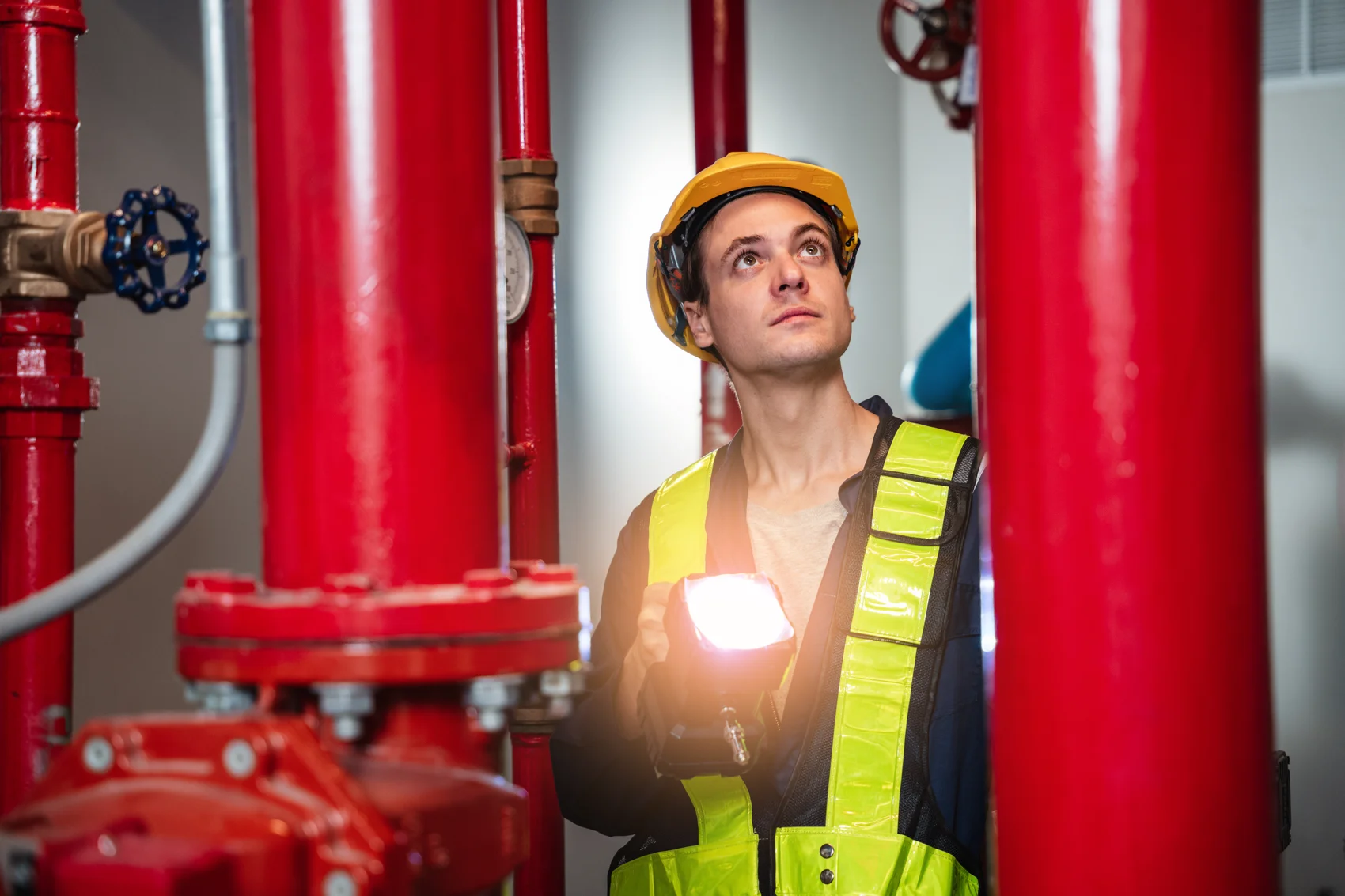
Getting fire protection design right matters. A poorly designed system means failed inspections, installation delays, code violations, and cost overruns. It means the fire marshal comes back with a list of corrections. Your timeline slips and your budget explodes.
Kauffman Co. designs fire protection across new construction, retrofits, and building upgrades in the Greater Houston area. From initial system engineering through CAD drawings, BIM coordination, and code compliance review, we design systems that install cleanly and protect your building for years.
One team. One point of contact. Design through installation.

A fire protection system is only as good as the design behind it. Get the design right from the start -– account for water pressure, sprinkler head placement, alarm coverage, suppression agent suitability, code requirements -– and installation is straightforward. Get it wrong, and you’re fixing problems on the fly.
That’s why we design systems with the installation in mind. Every line on the drawing, every specification, every coordination note exists to make sure the system performs when it matters and passes inspection without surprises.
New construction projects need design from the ground up. Existing buildings often need retrofits or upgrades to meet current code. Kauffman Co. designs the full range of commercial fire protection systems for all three scenarios.
Sprinkler head placement and water pressure calculations drive how a system performs. We calculate pipe sizing, account for redundancy, and verify that coverage meets code. The result is a system that works with your building’s layout, not against it.
Learn more: Fire Sprinkler Design and Installation
Where smoke detectors go matters. Pull station locations, horn and strobe coverage, control panel siting—code requires specific spacing, but we design to exceed those requirements. Every device ends up where it needs to be.
Not every hazard needs water. Clean agent systems protect server rooms. Foam systems handle flammable liquids. Kitchen hoods need wet chemical. We match the suppression agent to your specified risk.
Restaurant kitchens are a unique fire environment. Hood suppression systems, Class K extinguisher placement, and ventilation coordination all have to work together. We’ve designed these systems throughout Houston and understand what local fire codes require.
A fire pump has to deliver the right water pressure at the right volume. We size the pump, route the suction and discharge lines, and set pressure controls so that when sprinklers activate, water flows reliably.
Our process is straightforward. We listen to your project, take measurements, calculate what’s needed, coordinate with every trade that’s involved, and deliver drawings that work for you.
1. Understand Your Building & Code Requirements
We review architectural plans, determine building use and occupancy type, and identify which NFPA standards and local AHJ codes apply. Different building types have different fire risks, and the code reflects that.
2. Site Assessment & Measurements
We walk through your building and take measurements. We identify hazards, assess your water supply and electrical infrastructure, and understand the structural realities we’re designing around. For complex projects, 3D laser scanning gives us exact spatial data.
3. System Design & Engineering
Our team designs the system in CAD, working through water pressure calculations, flow rates, equipment placement, and code requirements. We don’t work in isolation. We coordinate with mechanical, electrical, plumbing, and structural teams to make sure the fire protection system fits cleanly into the larger building.
4. BIM Coordination & Virtual Design
On larger projects, we integrate fire protection into the building information model. We use virtual design and construction to catch conflicts before construction starts. A pipe clash found on screen costs you nothing. A pipe clash found during construction costs time and money.
5. Code Review & Documentation
We verify compliance with NFPa standards, Texas fire code, and local AHJ requirements. Drawings, specifications, and notes are all documented and ready for permitting and installation.
We use modern tools because they catch problems early and save money.
Fire protection doesn’t exist in isolation. We design in CAD and integrate into building information models so your system coordinates with mechanical, electrical, structural, and plumbing. Conflicts get resolved on screen, not during construction.
Learn More: BIM
For retrofits and complex existing buildings, we don’t guess measurements. 3D scanning captures exact spatial data so we know pipe routes, ceiling heights, and equipment placement. No surprises during installation.
Learn More: 3D Laser Scanning
We work in Revit to make sure fire protection integrates with the full building design from day one. Your system is coordinated with everything that affects placement and performance in mind: architecture, mechanical, and electrical.
Learn More: Revit Modeling
Before construction starts, we walk through the entire installation in 3D. This catches real problems early, like a pipe that conflicts with structural steel, or an access route that’s too tight. We figure out the best order to build everything so your project stays on schedule.
Learn More: Virtual Design & Construction
Our designers are licensed fire protection professionals, not subcontractors we’ve handed your project to. You work with the same team that will install what we design.
We design for new commercial projects. We handle residential retrofits and industrial upgrades. We know Houston code, local AHJ expectations, and what works in practice.
We design to NFPA standards, local AHJ requirements, and Texas fire code from the start. No surprises during permitting. No corrections during inspection.
We design it, then we install it. The team reviewing the drawings is the team running the installation. That continuity means better coordination, faster problem-solving, and systems that perform.
Yes. We provide complete design-build services for new commercial construction. That includes system engineering, CAD drawings, BIM coordination, and code-compliant layouts. We work with developers, architects, and general contractors to meet NFPA and local AJH requirements.
Yes. If you need an existing design reviewed, updated, or modified to meet current code or accommodate building changes, we can do that.
Absolutely. Every design we produce complies with NFPA standards, the Texas Fire Code, and local Authority Having Jurisdiction requirements. Code compliance is built into our design process from the start.
We design fire sprinkler, fire alarm, and fire suppression systems. We also handle fire pump systems and integrated fire protection for commercial buildings.
Yes. Our designers work with mechanical, electrical, plumbing, structural, and architectural teams to ensure proper system fit, utility access, and conflict-free installation. That coordination happens during design, not during construction.
Kauffman Co. provides fire protection design services throughout the greater Houston area.
Don’t split your design and installation between two companies. Kauffman Co. handles fire-protection design for new construction and retrofits, then installs the systems we design. One team. One point of contact. Complete fire protection.